Banish the Confusion Around Bunions.
Learn to Manage, Strengthen, and Support Your Feet.
Whether you are trying to halt the progression of your own bunion or help a client move better, this course reveals the mechanics, the myths, and the practical management strategies you need.
Is it just genetics? Is surgery inevitable?
In my clinic, the bunion (Hallux Valgus) is one of the most common conditions I see.
I see the full spectrum. I see the mild cases—people who have noticed a slight change in their foot shape and desperately want to prevent it from getting worse. I see the severe cases—where walking is difficult, shoes are painful, and daily function is compromised. And I see the post-surgical patients—those navigating the long road of rehabilitation.
But regardless of the severity, the fear is always the same: Is there anything I can actually do about it?
The answer is yes.
If we can address the issues early on, we can halt the progress, strengthen the feet, and potentially prevent future surgery.
The "Genetic Myth" That Keeps You Stuck
Here is the first thing you need to know: Babies are not born with bunions.
There is a common misconception that bunions are purely genetic. They are not. You may inherit a certain soft tissue type (laxity), but you do not inherit the bunion itself.
Bunions are primarily a result of weakness in the foot and functional changes that develop over time.
This is good news. It means that while you cannot change your genetics, you can change your function.
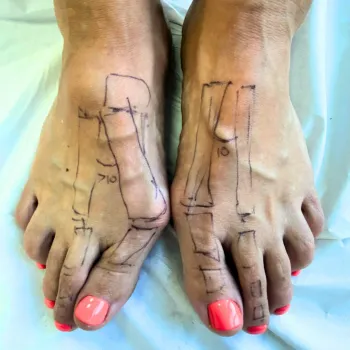
Introducing: Meet The Bunions
This isn't just a list of "toe wiggles." This is a biomechanical deep-dive designed by a Chartered Physiotherapist to help you understand the root cause of the deformity.
We move beyond the big toe and look at the whole picture—from the midfoot instability that starts the problem, all the way up to the hips.
Who Is This Course For?
For The Individual:
You have pain or a "red bump" forming and want to stop it in its tracks.
You struggle to find shoes that fit and want to wear comfortable footwear again.
You are scheduled for surgery (or have just had it) and want the best possible rehab outcome.
For The Professional:
You see clients whose knees roll in (valgus collapse) during squats, driving the foot into pronation.
You need safe, effective regressions for clients who cannot perform standard lunges or balance work due to big toe pain.
You want to understand the "Why" behind the bunion so you can programme more effectively.
What's Inside
Module 1: The Anatomy of a Bunion
To manage it, you must understand it. We break down the 3 sections of the foot (Hind, Mid, and Forefoot). You will learn why the bunion isn't actually a "growth" on the side of the foot, but an instability at the tarsometatarsal joint that causes the 1st metatarsal to drift.
Module 2: The Kinetic Chain (Hip & Brain)
A bunion doesn't happen in isolation.
The Hip Connection: Learn how a "rolled in" hip or an anterior pelvic tilt helps drive the foot into a bunion position—and how to fix it.
The Brain Connection: Re-establish the neural pathway to your feet. We use sensory stimulation to wake up the "tripod" of the foot (heel, big toe, little toe).
Module 3: The Toolkit (Exercises & Management)
This is the practical "how-to" section. You will master specific techniques including:
Hands-On Release: Massage techniques to mobilise the arch and separate the toes.
The "Foot Screw": A technique to actively correct the big toe position.
Big Toe Abduction: Strengthening the Abductor Hallucis muscle to pull the toe straight.
Band Work: Using resistance bands (or even a hair scrunchie!) for gentle alignment.
Module 4: Don't Forget the Little Toe
We also cover Tailor’s Bunions (bunions on the 5th toe). Learn why narrow shoes and stiff big toes can cause you to roll outward, creating a painful bump on the little toe.
Module 5: Lifestyle, Footwear & Spacers
Toe Spacers 101: How to choose them, why you shouldn't wear them overnight, and how to exercise in them.
Footwear: Why flip-flops cause toe gripping and how to transition to wide toe box shoes.
Learn From a True Expert in
Foot & Ankle Rehabilitation
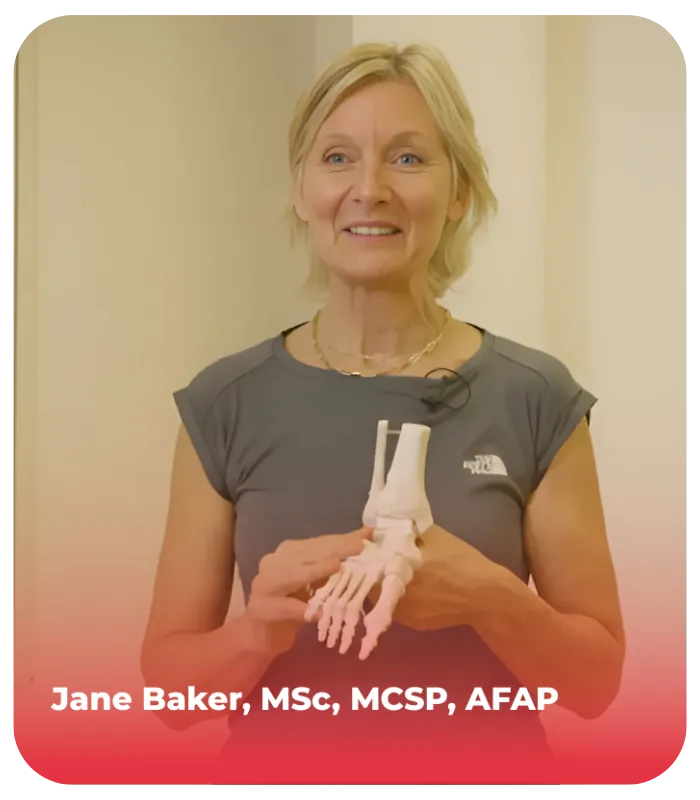
Foot and Ankle Specialist Physiotherapist and a member of the Association of Foot and Ankle Physiotherapists.
With over 30 years of experience in private practice, Jane Baker isn't just another online course creator. She's a board-certified physiotherapist who has dedicated the last 15 years to specialising in foot and ankle rehabilitation, working alongside leading surgeons and podiatrists in London.
Jane's Approach Makes The Difference:
• 30+ years of hands-on physiotherapy experience
• 15 years specialising in foot and ankle rehabilitation
• Works directly with leading foot and ankle surgeons
• Focuses on treating causes, not just symptoms
• Specializes in getting clients back to activity - from elite athletes to everyday movement
Professional Credentials:
• Member of Chartered Society of Physiotherapy (MCSP)
• Member of Health Professions Council (HPC)
• MSc Health Administration
• Member of the Association of Foot and Ankle Physiotherapists (AFAP)
Advanced Specializations:
• Biomechanics of the Lower Extremity
• Foot Mobilisations Technique
• Functional Movement Assessment
• Running Injuries Specialist